
Zone and Division on one label
Section 18 classifies by Zone while Annex J18 keeps the Division system, so buyers ask for both. The marking target is II 2 G Ex ib IIC T4, with Class I Division 1 pursued on the same intrinsic safety basis.
The IS-04Z1 is an Ex phone for people working inside classified areas at Canadian oil sands plants, gas plants, refineries and offshore platforms. It is pre-launch: certification through a body accredited by the Standards Council of Canada, and ISED radio certification, are both in progress for a Q4 2026 launch. Often searched for as an “explosion proof phone”, the IS-04Z1 uses intrinsic safety as its protection concept.
Launching Q4 2026 · CSA C22.1 route and ISED certification in progress

 CSA C22.1 · SCC-accredited certification
 IECEx
 ATEX 2014/34/EU
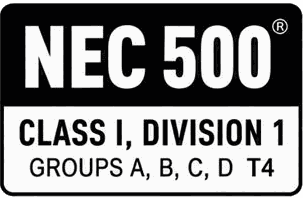 NEC 500 Class I Div 1IP68Zone 1 / Zone 21
 Android 16
 Qualcomm Snapdragon
Demand sits in a few regions far apart from each other, each loading a handset differently: the oil sands cold and remote, Sarnia dense and continuous, the Grand Banks weather-bound.
Operators and contractors such as Suncor Energy, Cenovus Energy and Imperial Oil need an explosion proof mobile phone they can carry into classified areas at Athabasca oil sands, Cold Lake and the Lakeland and Alberta Industrial Heartland. The IS-04Z1 is designed for Zone 1 and Zone 21 duty there.
Five questions decide a Canadian specification, and four of them are about winter.
For evaluators in Canada, the IS-04Z1 explosion proof mobile phone is designed around these points: Zone and Division on one label; The ambient range on the certificate; Combustible dust, not only gas; Long routes, cold batteries; Heavy gloves, one usable hand; Both official languages, centrally managed.
Section 18 classifies by Zone while Annex J18 keeps the Division system, so buyers ask for both. The marking target is II 2 G Ex ib IIC T4, with Class I Division 1 pursued on the same intrinsic safety basis.
Unless a certificate says otherwise, hazardous area equipment is assessed for -20 to +40 degrees Celsius. Before a January shift at Fort McMurray that matters more than the drop rating. The marked range is published when the certificate issues.
Sulfur handling at an upgrader, coke and coal transfer, grain terminals and pellet plants are dust locations where a gas-only fleet stops. The Zone 21 design target covers both.
A pad route north of Fort McMurray puts hours between charging points, and every battery gives up capacity in the cold. A 4,000 mAh cell, a Snapdragon octa-core platform and four-constellation GNSS suit a shift away from the truck.
Winter gloves, FR coveralls and a fixed ladder leave one hand for the work and none for a notebook. A 50 MP camera with PDAF and NFC capture an asset tag where it is found.
Android 16 runs the interface in English and French, which matters for crews in Quebec. EMM and MDM enrollment locks a device to an approved app set and wipes it at demobilization.
Canadian authorities want a mark from a body accredited by the Standards Council of Canada, so that certificate, and the ambient temperature range printed with it, are what a site inspector reads.
The code your electrical inspector works from is CSA C22.1, the Canadian Electrical Code, adopted into law province by province. Section 18 classifies explosive atmospheres by Zone, while Annex J18 keeps the older Division system for installations built and maintained that way. That is why one operator calls an area Zone 1 IIC and the plant down the road calls it Class I Division 1 Group B. Rule 18-050 decides the purchase: equipment in a Zone location must be designed, tested and certified for the atmosphere and equipment group present, by a certification body accredited by the Standards Council of Canada.
Two further approvals sit beside it. Any radio device sold or operated in Canada needs ISED certification against RSS-Gen and the applicable Radio Standards Specification, with RSS-102 covering radio frequency exposure, and the IC number has to appear on the product. The duty to use suitable equipment falls on the employer under provincial health and safety law, and the authority enforcing the code differs by province: Alberta Municipal Affairs and the Safety Codes Council issue STANDATA interpretations of Section 18, Technical Safety BC administers it in British Columbia, and the Electrical Safety Authority does so in Ontario. Work on the Grand Banks adds the Canada-Newfoundland and Labrador Offshore Energy Regulator, renamed from the C-NLOPB in 2025.
Typical Zone 1 and Zone 21 duty for the IS-04Z1 explosion proof mobile phone in Canada includes: Winter rounds at a central processing plant; Turnaround work on the St Clair; Commissioning and marine handover at Kitimat; A rotation on the Grand Banks.
Froth treatment, diluent recovery and tank areas at an Athabasca plant are classified, and in February the walk between them is the expensive part of any query. An Ex phone lets an operator log a reading and reach the control room mid-round.
A Sarnia turnaround pulls hundreds of trades through one classified footprint on overlapping permits, then disperses them. A handset enrolled in the site MDM keeps the job pack, the isolation photograph and the supervisor call in one auditable system.
Liquefaction trains, the loading jetty and the gas plants behind them run simultaneous operations with commissioning crews still on site. One device for voice, checklists and photographs removes the paper step between the work front and the coordination room.
On a Jeanne d’Arc Basin platform the weather decides when the next helicopter arrives, so a failed handset stays failed for days. IP68 sealing, rugged build, platform Wi-Fi and Bluetooth pairing to gas detection are what that needs.
Nothing goes past a classified boundary before the certificate exists, so the pre-launch process is about evidence, cold weather evaluation and a supply route.
Tell us whether areas are described by Zone or Division, the gas or dust group, the province whose electrical authority will see the device, and whether units are company or contractor issued.
You receive the current datasheet and a written schedule of every certification being pursued, with the status of each and the body handling it. Nothing is complete until the certificate exists.
Evaluation units go to sites that will test them properly, and Canadian trial places are allocated so units are in the field through a real winter.
Hazardous area devices normally reach a Canadian site through industrial safety and electrical distribution. That distribution is being appointed now, with direct supply to national accounts.
Send your site, zone and gas group, and we will answer for your plant rather than in general.
Ask about Canada →No. It is designed for Zone 1, Zone 21 and Class I Division 1 duty and certification is in progress ahead of the Q4 2026 launch. Until a certificate from an SCC-accredited body exists we will not describe it as certified.
Buyers use flameproof, exproof and Ex proof phone for the same thing, but they are different concepts. Flameproof, Ex d, contains an ignition inside a heavy enclosure and suits fixed equipment. Handhelds take the intrinsic safety route, Ex ib, which limits available energy.
No. A Canadian inspector looks for a mark from a body accredited by the Standards Council of Canada. Many laboratories run both assessments together and issue a combined mark, but it is the Canadian side of it that counts.
The governing number is the ambient range on the certificate, not the drop rating. Assessment covers -20 to +40 degrees Celsius unless the certificate states otherwise, so we publish the marked range when it issues. Batteries also lose capacity in deep cold.
There is no published price for a device whose certificate has not issued. Pre-launch pricing is given on request once we know fleet size, configuration and supply route. Evaluation units go out under a trial agreement rather than sold.
Android 16 runs the interface in French as well as English, and French user documentation is part of the launch package. Buyers in Quebec should ask for the French manual and label copy when the certification schedule is sent.
It is designed for Zone 1 offshore duty, with IP68 and rugged build and Wi-Fi where cellular coverage stops. ISED certification, required before any radio device is sold here, is part of the same launch program.
Tell us the site, the zone and gas group, and roughly how many handsets. The SAMS team replies by email with the datasheet and the certification schedule for Canada. The IS-04Z1 is pre-launch and certification is in progress, so there is no list price yet; indicative pricing is issued in writing against a stated quantity and site.
SAMS Mobile is appointing Canadian distribution ahead of the Q4 2026 launch, with priority on partners already selling industrial safety and electrical products into the oil sands, the Edmonton region, Sarnia, northeast British Columbia and Atlantic Canada.
Go deeper with the IS-04Z1: explosion proof phone for LNG, gas & offshore; explosion proof phone for Oil sands & heavy oil; explosion proof phone for Refining & chemicals; explosion proof phone for Canadian Natural Resources; explosion proof phone for Cenovus Energy; explosion proof phone for Imperial Oil; explosion proof phone for LNG Canada; explosion proof phone for Suncor Energy.
Buyers look for the IS-04Z1 in Canada in different ways. Each guide below answers one buyer search honestly: what the term means, the route to buy, and where certification stands today.